
uniquely asymmetrical
I finally made a Zome model of what B. Fuller calls The Coupler (insert dramatic chipmunk here). This polyhedron is what I am planning on using as the module for all this madness. This Coupler is an asymmetrical Octahedron – one B. Fuller refers to as “uniquely asymmetrical”. And really, who am I to say differently.
Behold The Coupler:

In the image above, the blue struts are the same blue struts from the Cartesian orthogonal basis we all know and love, pulled from the innards of two face bonded Rhombic Dodecahedrons.

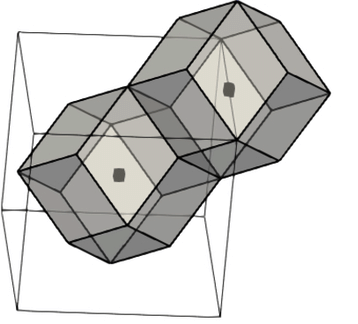
The diagram above provides the context for the derivation of this coupler. Here we have two rhombic dodecahedrons shown in the correct orientation with respect to the cubic grid we all know and love. The coupler is the octahedral shape that is formed by the combination of the centers of these two FCC cells and the rhombic face joining them.

My light box thingy is too small to capture its full majesty, but the image above shows my Zome model of these two Rhombic Dodecahedrons joined by a common face. The centers of the Dodecahedrons are the red spheres. The center of the coupler is represented by the yellow sphere. The two green struts in the picture are the diagonal joining the two cell centers.

The image above is a somewhat better view. It’s a closeup of the coupler embedded in the face centered cubic grid. You can see the blue struts of the cubic grid forming the long axis of this asymmetrical octahedron. The green struts are the diagonals of the square these blue struts form. For now, just marvel at its coolness.

One thing that should hopefully be clear about the coupler is that this asymmetrical octahedron is also an all space filler. An all space filler is a shape that, like a cube, you can just stack and pack the coupler and you’ll fill all of space. Quite cool. It also has a volume of 1 when compared to the base unit tetrahedron volume of 1, which makes it super, super cool.
Why? because The Coupler is what I intend to use as the unit for my wacky spatial caching/modularization scheme. Recall that I planned on using a grid composed not of packed cubes, but of packed spheres. While there are a number of ways to represent the packing of spheres, my choice is to use the voronoi polyhedron of the cell center, the Rhombic Dodecahedron, as the representation of each and every cell. This Rhombic Dodecahedron grid is a face centered cubic grid. Each cell has 12 face coupled neighbors.
Note that this FCC packing is the densest sphere packing of space, coming in at almost 75%, whereas the cube is just barely above 50%. This provides – at least from my naive POV – a superior way of addressing positions in space, finding the particular chunk you need quickly and efficiently, navigating through this space, modularizing and organizing its storage. This grid’s high density means there is far less distortion in various transforms we’ll end up using to map from our grid space to what will be the real, simulated 3D space. We can even leverage the voxel representation of all this – i.e. digital geometry, Minecraft type geometry. The digital geometry of all this is also amazing cool.

Having 12 face neighbors instead of 6 is a pretty huge advantage. The eight vertex neighbors of the cube make for a well known paradox of “which way do I take” because of the hilarious way you orient cubes around a vertex, not to mention diagonals rule the spatial modularization that results and the square root of two spoils every single party you throw. Like hexagonal grids in 2D, the major pieces of the system are largely rational and paradox free.
A Couple Of Things
Anyways…

As mentioned previously, my focus now is on decomposing the coupler, modeling, and working on a data structure suitable for spatial caching. The goal of this is to be able to navigate through a large amount of spatial content – primarily 2.5D, I’m sure, but 3D is really what I want to deal with – and stream that content dynamically, rather than using existing pre-deployed content. There’s a large amount of large scale distributed systems engineering thrown into that mix, as it’s not just simply abstract geometry, so hopefully that will be interesting when that begins in earnest. At least there I’ll be leveraging a lot of preexisting work of my own, rather than having to discover and derive it 😀.
It’s rather cool that the modular model that joins the two spaces between two cells turns out to be an all space filler. The upshot of this is that the coupler is basically universally relocatable. Any coupler can substitute for any other coupler and so can be rotated and translated from any position within a cell to any other position within the cell or the entire grid. We already have this in the cube, but now instead of being restricted to 6 faces in common we have 12 for the cell (the rhombic dodecahedron) and another sub modularization (the coupler), which is an all space filler and has 8 face neighbors.

But we can go even further with the subdivisions. It gets quite maddening, of course, and I’m still in the process of getting a framework for this in my graphics so I can start illustrating and creating grid as well as other abstractions so I can start using it in code and systems.
There’s a couple of diagrams that provide good views of how this seems likely to work out… my belief is that I can leverage the work already done by Fuller and a host of others on the subdivision of sphere packings and their grids. This process ultimately grounds out in the derivation of the A and B modules (both asymmetrical tetrahedrons). That it grounds out at all is an interesting thing in and of itself, but I’m more interested in the engineering aspects, not the theory behind it for this project.

See, B. Fuller has really done yeoman’s work already in this particular area of my interest (ok, madness). In particular, the analysis that he’s done wrt subdividing and decomposing grids formed by the closest packing of spheres. In the diagram above, you can see how to subdivide the standard tetrahedron to get the A module. This tetrahedron comes from a vector equilibrium (cuboctahedron) grid that is ultimately composed of a mesh of tetrahedrons and octahedrons. It’s one of the frustratingly maddening things about sphere packing is that the lattice isn’t a single polyhedron, at the base of the way we can organize the space of sphere packings. lol. You can’t fill all space with only this symmetric octahedra or only this symmetric tetrahedra.
Fuller’s work on subdividing the space of tetrahedrons and octahedrons becomes something I can leverage. The above A module willis one part of the story. As the subdivision above shows, this is a modular subdivision of the regular tetrahedron.

And if there is an A module, there must of course be a B module. The B module is derived through the subdivision of the symmetric Octahedron of the cuboctahedron grid. So what? you might be saying. Well, what’s weird is you can now combine A and B modules together to make an astounding number of solids and other such things simply by rearranging their orientation in space. Something quite surreal and without computer animation, exceedingly hard to illustrate.

One can construct the coupler from A and B modules, which shouldn’t surprise us at this point. What is rather surprising (to me, at least when I learned about it) is that we can rearrange the A and B modules within the coupler to get different orientations within the same oriented spatial volume and shape.

These sub modules are all tetrahedrons and ultimately ground out into the non all space filling A and B modules. These tetrahedrons, in my opinion, are the perfect shape for storing spatial content in this grid.
Why not cubes, then?
Well, if you haven’t noticed it’s not like we really have gotten rid of them. They’re always there, always in the background and many times in the foreground! But they’re not the fundamental shape that we’re using. Rather, what we find is that cubes and such things are derived, rather than fundamental. Other work I’ve been doing with Delaunay meshes and grids used for kinematics tracking, navigation, graphic meshes and physics fits perfectly and most naturally into a tetrahedral framework for organizing spatial relationships, both static and dynamic. Finding nearest neighbors and all sorts of things become almost trivial and most efficient in these forms of spatial organization.
Finally, go read B Fuller waxing poetic about the Coupler. I won’t apologize for the man, and yea it’s way over the top. It’s how the man writes. But frankly, The Coupler is an amazing geometric object and really does have a rather interesting place in the hierarchy of things and how one goes about subdividing and organizing space.

Leave a Reply